Make inversion workbench part of your practice
The Inversion workbench compares a triad in root position and in its two inversions. It is useful for hearing how the same pitch classes sound different when the lowest note changes, which is the basis for understanding bass motion and voice leading.
What the result shows
The workbench lists three bass positions of the chosen triad. Inversion is determined by the lowest chord tone: root position has the root in the bass, first inversion has the third in the bass, and second inversion has the fifth in the bass. Moving the bottom note up an octave keeps the same pitch classes, so the chord name does not change even though its sound does. The selected position is highlighted on a keyboard, and the audio preview plays only that one finite example, not a continuous loop.
Why it helps
Harmony often depends on which note is lowest. Hearing the three positions side by side trains you to notice the bass as a separate layer from the chord identity. This matters when you read figured bass, plan a bass line, or judge whether a chord change feels stable or unsettled. Comparing shapes across chord qualities also shows that major, minor, diminished and augmented triads each have different interval structures, so their inversions sound different in their own way.
Limits of the comparison
The positions shown are closed triad positions, not fingering instructions or every possible voicing. A symmetrical augmented triad can be heard or labeled in more than one harmonic context, so the label alone does not settle how it functions in a passage. The tool does not measure whether a position is easy to play on your instrument.
Try it step by step
- Choose C from Root / tonic, set Chord quality to Major, and set the Position field to 0. Say the bass note aloud before pressing play for the root-position preview.
- Change the Position field to 1 and repeat, saying the bass note first. Then change it to 2 and repeat again.
- Reverse the order: set Position to 2, then 1, then 0, saying the bass note each time. This checks that you can name the lowest note without relying on the highlight.
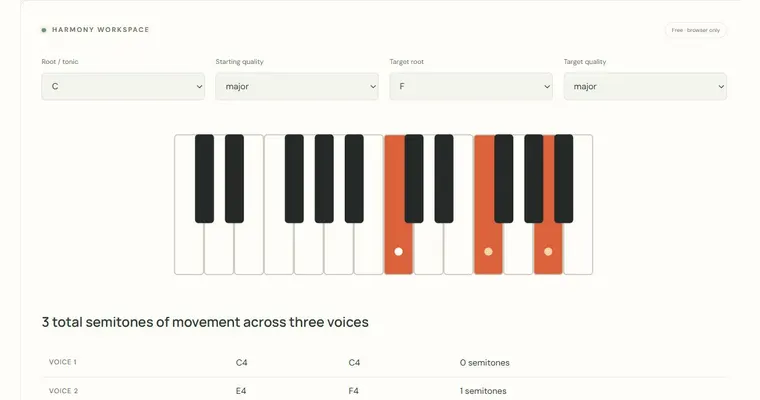
- Change Chord quality to Minor and repeat the three positions. Compare how the intervals above the bass differ from the major version, then carry the comparison into the voice-leading tool.
A concrete example
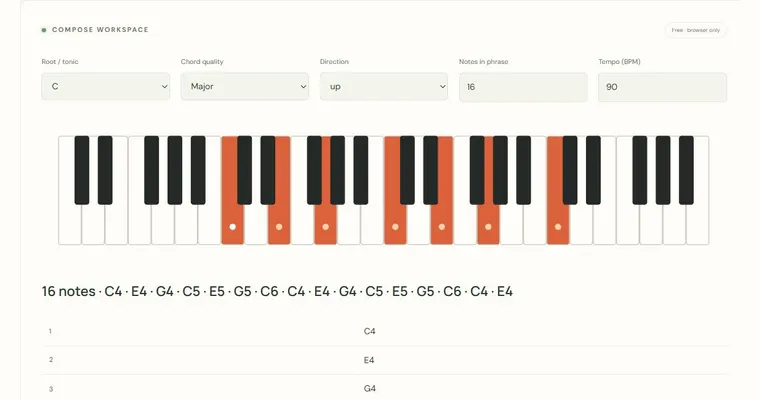
C major is C4, E4, G4 in root position; E4, G4, C5 in first inversion; and G4, C5, E5 in second inversion. The pitch classes are C, E and G in each case, so the chord is unchanged while the bass moves from C to E to G. From the bass to the next note, root position has a major third, first inversion a minor third, and second inversion a perfect fourth (G up to C).
A common wrong turn
Treating the second inversion of a triad as a different chord, or assuming the chord name changes when the bass changes.
Try this instead: Recheck the pitch classes. If the same three pitch classes sound, the chord is the same and only the bass has moved. Name the lowest note first, then check the remaining notes against the root, third and fifth.
Where to go next — and why
This guide was drafted with Claude Haiku and edited against this tool’s implemented controls. Report a confusing instruction or incorrect example.