Chord & harmony tools
Find chords, inspect keys, construct written harmony and connect a progression.
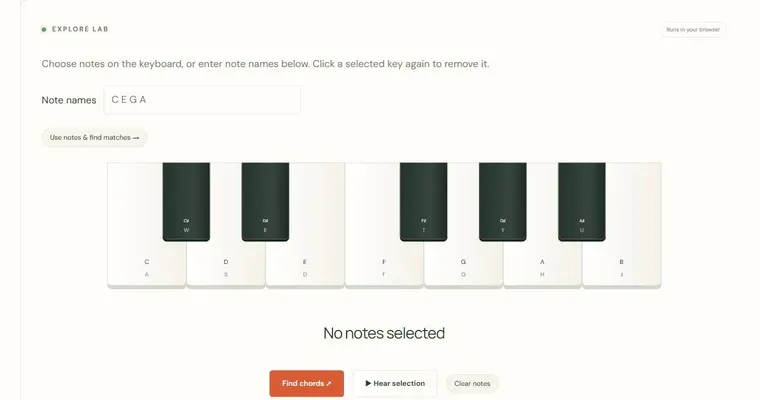
Chord finder
Choose notes on a keyboard and find matching chord references.
Open tool & guide →Harmony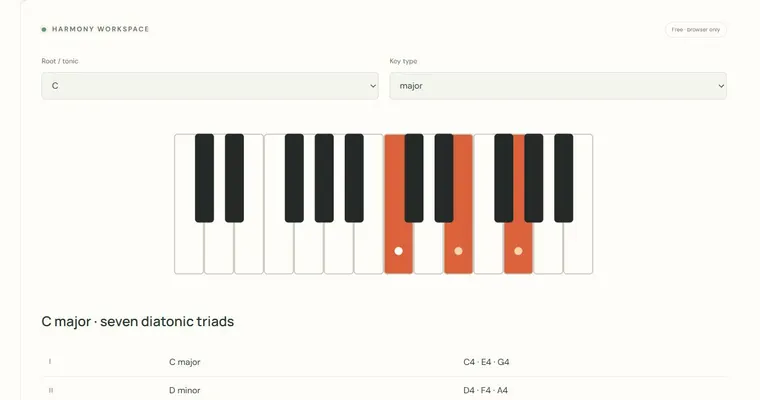
Chords in a key
Build all seven triads from a major or natural-minor scale.
Open tool & guide →Harmony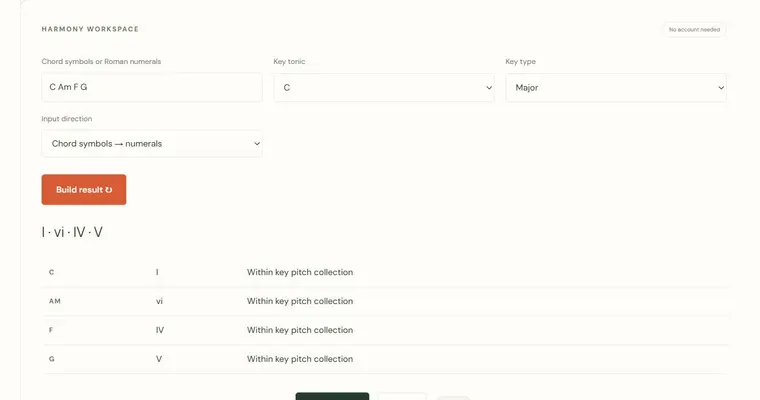
Chords ↔ Roman numerals
Convert chord symbols to scale degrees, or Roman numerals to chords.
Open tool & guide →Explore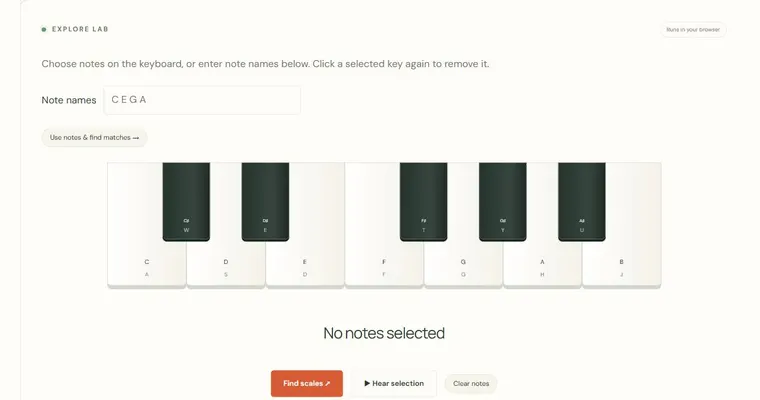
Scale finder
Find published scales that contain your chosen notes.
Open tool & guide →Compose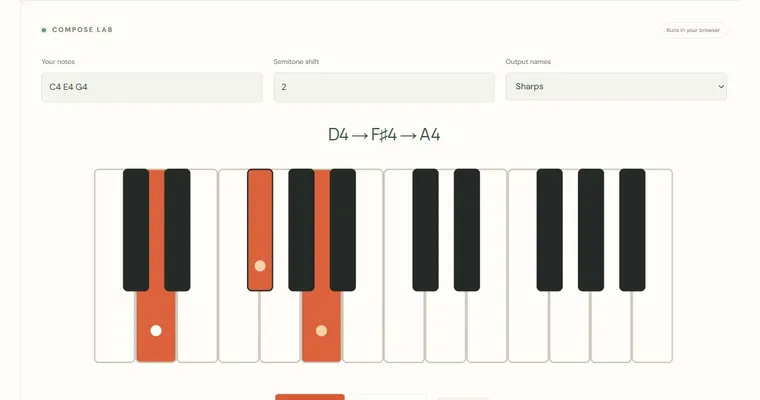
Note transposer
Move a phrase to another register or key by semitones.
Open tool & guide →Compose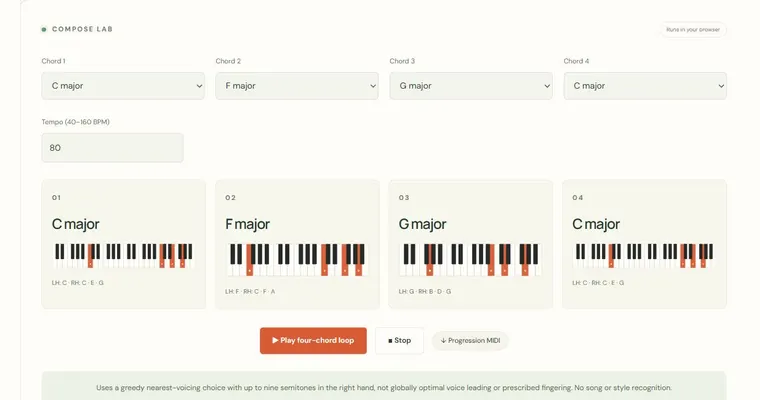
Progression builder
Build a four-chord loop with compact upper voicings.
Open tool & guide →Harmony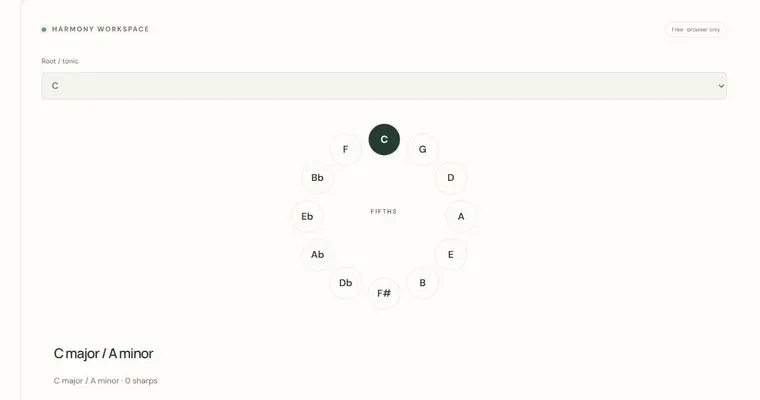
Circle of fifths
Explore fifth relationships, neighboring keys and relative minors.
Open tool & guide →Harmony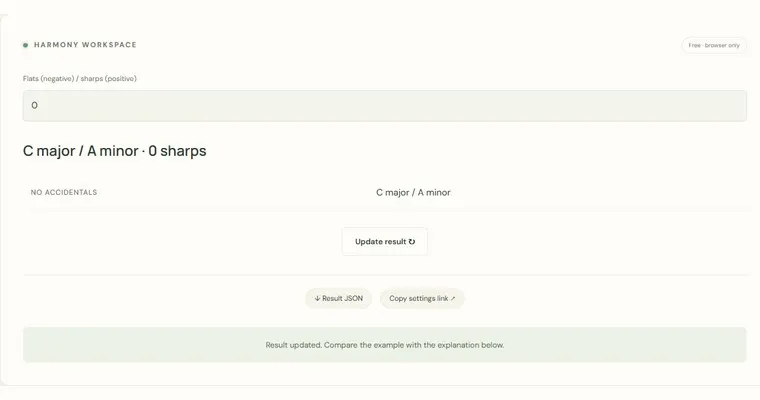
Key signature calculator
Read the sharp or flat order and the major/minor key pair.
Open tool & guide →Harmony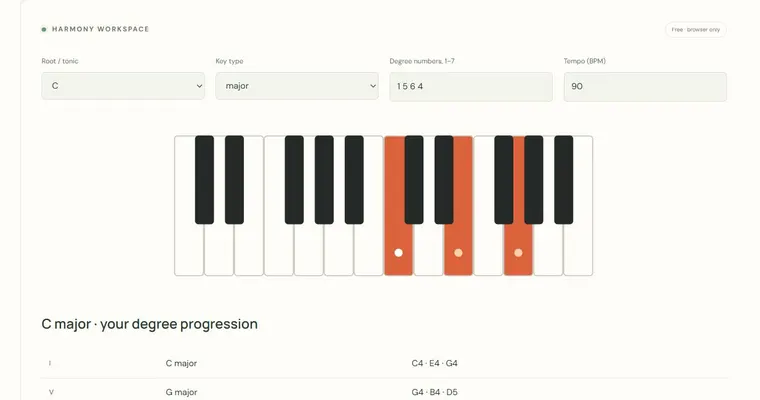
Scale-degree progression translator
Turn degree numbers into a playable progression in a chosen key.
Open tool & guide →Harmony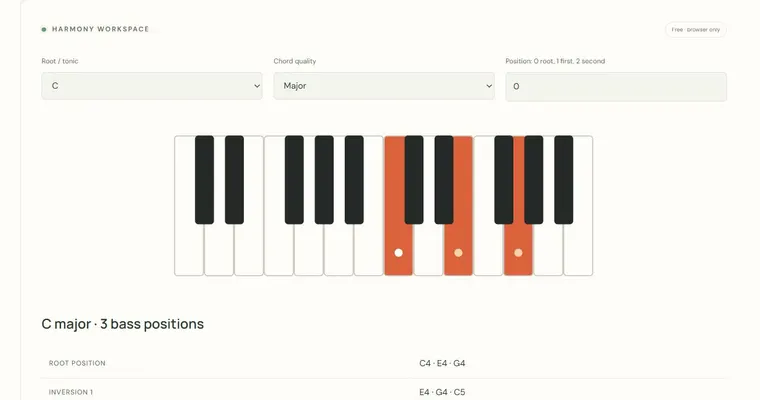
Inversion workbench
Compare a triad’s root position and two inversions.
Open tool & guide →Harmony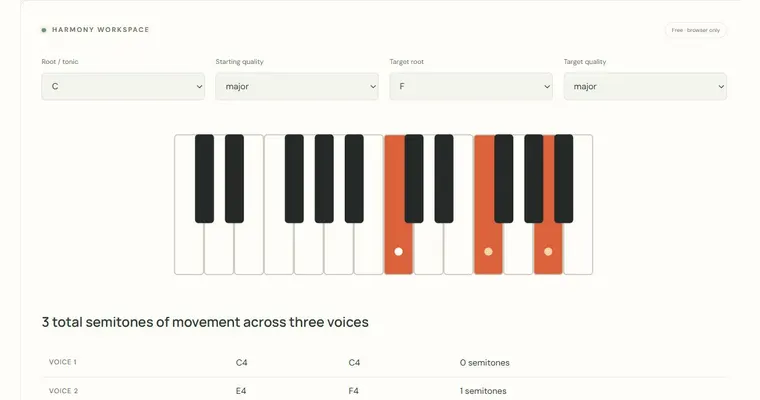
Two-chord voice-leading calculator
Find a nearby target inversion and inspect every voice’s movement.
Open tool & guide →Harmony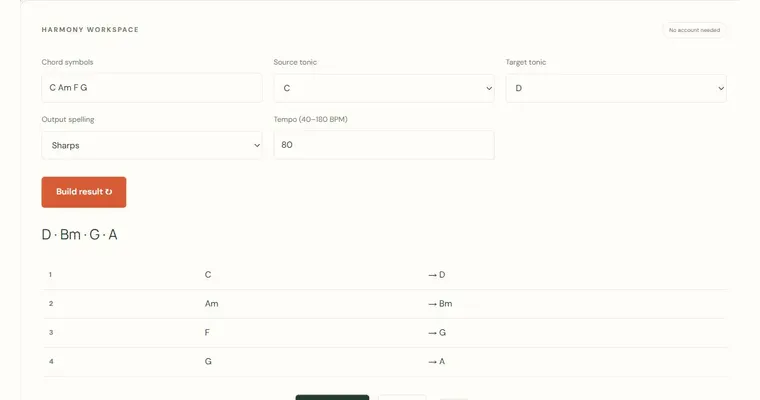
Chord progression transposer
Move chord symbols, including slash bass notes, to another key.
Open tool & guide →Train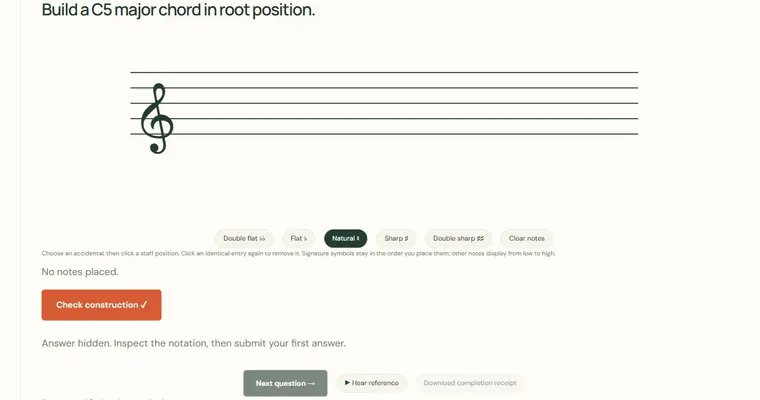
Chord construction on the staff
Construct triads and seventh chords as correctly spelled root-position stacks.
Open tool & guide →Train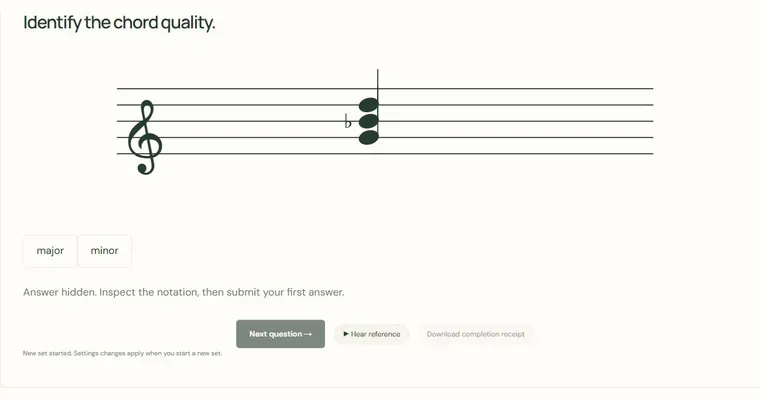
Chord identification on the staff
Recognize root-position triads and seventh chords from written notation.
Open tool & guide →Choose the next useful question.
Use the reverse chord finder when you already have a set of piano-key pitches. Use chords in a key when you want the diatonic collection under an explicit tonic. Written construction then makes spelling and octave placement visible: an enharmonic substitute can occupy the same piano key while expressing another interval. Progression tools help transpose symbols, compare compact voicings, label Roman numerals or prepare a printed chart. A selected key is an assumption to inspect, not an automatically discovered fact about a song.
Each linked workspace has its own example, controls and limitations. Keep the first set short enough to inspect every answer. When a result is surprising, connect it to a reference diagram or write the same pattern yourself before increasing difficulty. The aim is a repeatable observation you can take to an instrument, not a larger score without understanding.
Explore a related area
Theory reference room · Printable piano books · Resources for teachers