Pitch, tuning & sound references
Compare frequencies, harmonics and intervals, or estimate a sustained microphone pitch.
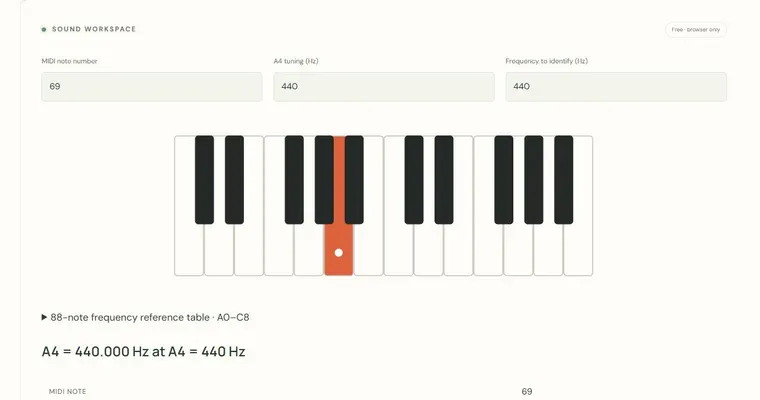
Pitch & frequency calculator
Convert MIDI pitches to hertz and find the nearest note to a frequency.
Open tool & guide →Sound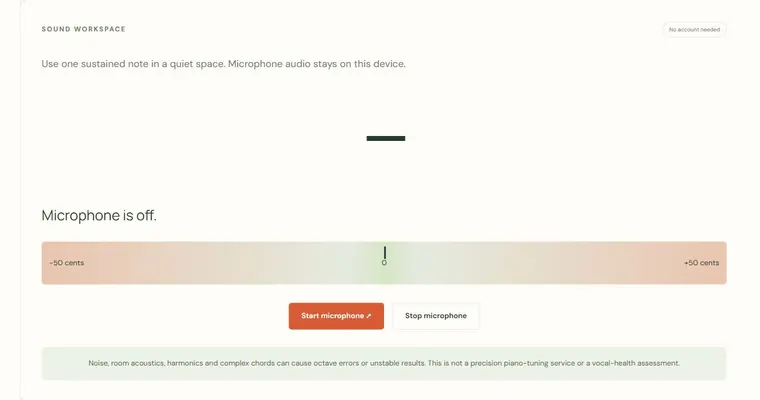
Microphone pitch tuner
Estimate a steady monophonic pitch after explicit microphone permission.
Open tool & guide →Sound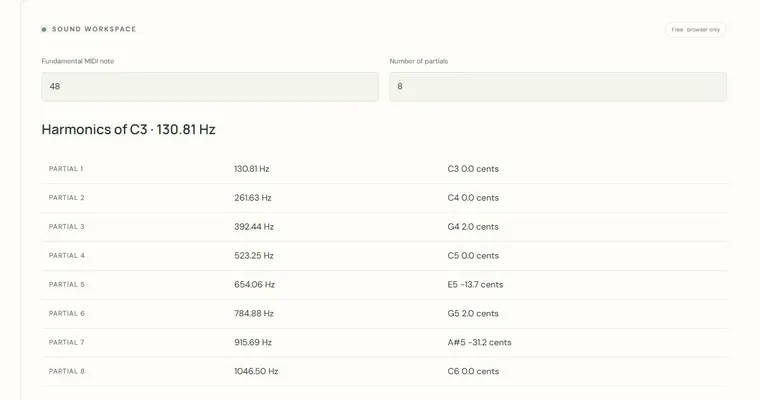
Harmonic series explorer
Compare exact harmonic frequencies with nearby equal-tempered notes.
Open tool & guide →Explore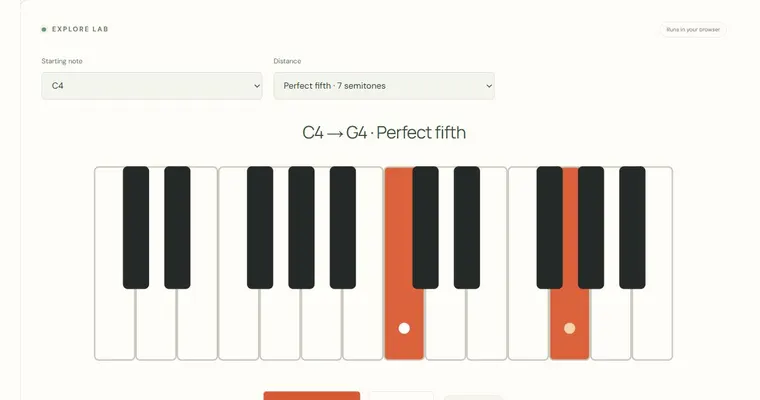
Interval explorer
See and hear the distance between two notes.
Open tool & guide →Compose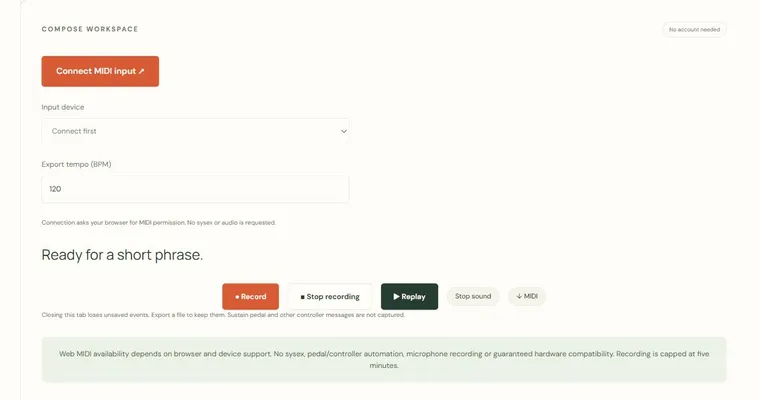
MIDI keyboard recorder
Capture note events from a MIDI input, replay them and export a .mid file.
Open tool & guide →Compose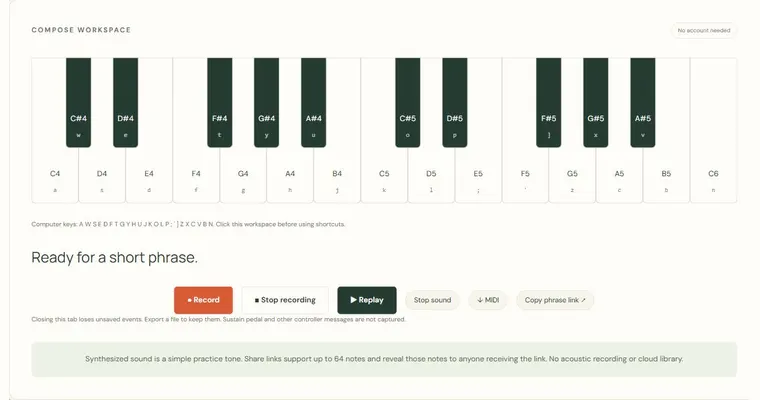
Virtual piano & phrase recorder
Play screen or computer keys, record note durations and share a short phrase.
Open tool & guide →Choose the next useful question.
A frequency table gives an equal-tempered reference under a chosen A4 tuning. A harmonic-series calculator instead explores integer multiples of a fundamental; those relationships are not interchangeable. The tuner estimates one sustained pitch after microphone permission, with all signal processing on the device. Noise, harmonics and input quality can affect the estimate. MIDI recording captures note-event data from an explicitly connected input, while the virtual piano records screen or computer-keyboard notes. Neither recorder captures the sound of an acoustic instrument.
Each linked workspace has its own example, controls and limitations. Keep the first set short enough to inspect every answer. When a result is surprising, connect it to a reference diagram or write the same pattern yourself before increasing difficulty. The aim is a repeatable observation you can take to an instrument, not a larger score without understanding.
Explore a related area
Theory reference room · Printable piano books · Resources for teachers