Make chords in a key part of your practice
The Chords in a key tool builds all seven triads that grow out of one major or natural-minor scale. Pick a root and key type, and it shows each scale degree, its chord root, chord quality, and the actual pitches, then plays the seven triads in order. Use it to understand why a key's chords behave the way they do, and to check your predictions against the calculator's output.
What the result shows
Each row corresponds to one scale degree, from one to seven. The chord is built by taking that scale note, then the note a third above it, then the note a fifth above it, staying inside the selected collection of pitches. Because every chord comes from the same set of notes, the results share a common pitch collection, which is why the key feels unified. The displayed quality tells you whether each triad is major, minor, or diminished, and the pitch list lets you see exactly which notes are involved. Note spellings follow the chosen key, so the letter names you see are the ones a musician would write on a staff.
Why the qualities differ by degree
Triad quality depends on the thirds formed within the selected scale. Major gives I, ii, iii, IV, V, vi, vii diminished. Natural minor gives i, ii diminished, III, iv, v, VI, VII: degrees one, four and five are minor; three, six and seven are major; two is diminished. In natural minor the fifth-degree triad contains the unraised seventh scale degree. Raising that degree, as in harmonic minor, can create a major fifth-degree triad.
Why this helps
Knowing the chord qualities for a key lets you predict harmony before you hear it. Once you can name the degrees, you can read a chord chart in any key without memorizing separate lists. Comparing the results for different roots also shows what stays fixed: the pattern of qualities across the seven degrees is identical for every major key, and likewise for every natural minor key. This tool does not track your progress or guarantee any particular learning result; it simply gives you a clear reference you can test against your own ears and at a physical instrument.
Try it step by step
- Set Root / tonic to C and Key type to major, then predict the quality of degrees one, four, and five before looking at the result.
- Read the displayed table and check each chord root, quality, and pitch list against your prediction.
- Change Key type to minor, keep the root at C, and identify which qualities changed compared with major.
- Play the seven triads on a physical instrument such as a piano to hear the same chords the tool plays; this part happens outside the tool.
A concrete example
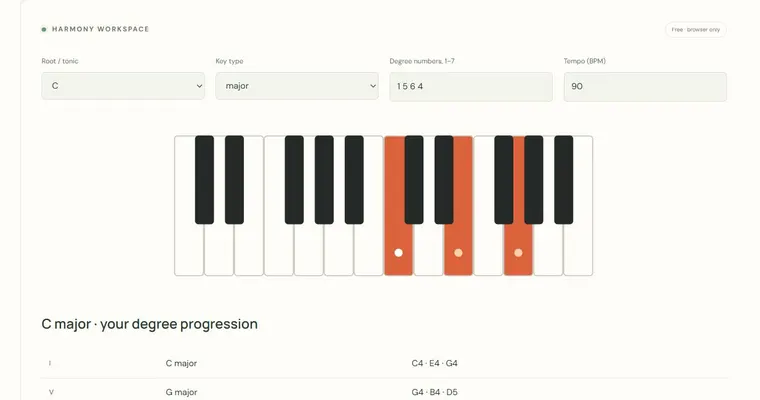
In C major the chords are C major, D minor, E minor, F major, G major, A minor, and B diminished. Degree one (C) is major because its third (E) is four semitones above and its fifth (G) is seven semitones above. Degree five (G) is major because G to B is four semitones and G to D is seven. In C natural minor, degree five becomes G minor, with B flat instead of B, so the third above G is three semitones and the chord is minor.
A common wrong turn
Assuming the fifth degree of every minor key is a major chord, so E major appears in A natural minor.
Try this instead: In natural minor the seventh degree is not raised. For A natural minor, degree five is E minor (E, G, B), not E major (E, G sharp, B). The major version belongs to harmonic minor, which this tool does not build.
Where to go next — and why
This guide was drafted with Claude Haiku and edited against this tool’s implemented controls. Report a confusing instruction or incorrect example.