Make chord quality ear trainer part of your practice
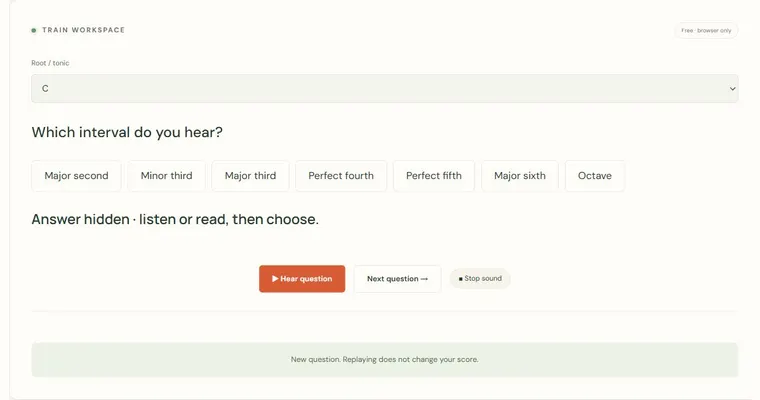
The Chord quality ear trainer asks you to hear a root-position triad and decide whether it is major, minor, diminished or augmented. The root stays fixed across questions, so your attention goes to the changing third and fifth. Use it to build a reliable ear for the sound of each triad quality.
What a correct answer means
A correct answer shows that you recognized the internal interval pattern of a triad built on a fixed root. Each quality has a formula in semitones: major is 0-4-7, minor is 0-3-7, diminished is 0-3-6 and augmented is 0-4-8. Naming the quality is different from naming the notes, so a correct answer means you can separate the third and fifth from the root rather than memorizing absolute pitches.
Why keeping the root constant helps
Keeping the root fixed lets you concentrate on the notes above it. Compare the third and fifth rather than relying on a generic happy/sad label. Major and minor share a perfect fifth; diminished narrows that fifth by one semitone and augmented widens it by one. The exercise offers repeated comparisons, but success with these synthetic examples does not guarantee recognition in every musical setting.
Using the result to guide practice
Use a missed question to choose a specific comparison. Minor and diminished both have a minor third, so inspect the difference between their fifths after the answer is revealed. The score is a total for this tab and does not provide a per-quality report. Questions use root-position triads with one synthesized timbre; inversions, extended chords, recordings and external instruments are not scored.
Try it step by step
- Set the Root / tonic field, then press replay to hear one hidden question.
- Replay the question and focus first on the third, then on whether the fifth matches, narrows or widens a perfect fifth. The timbre and root stay fixed for this comparison.
- Select one answer among major, minor, diminished and augmented, then read the revealed semitone formula.
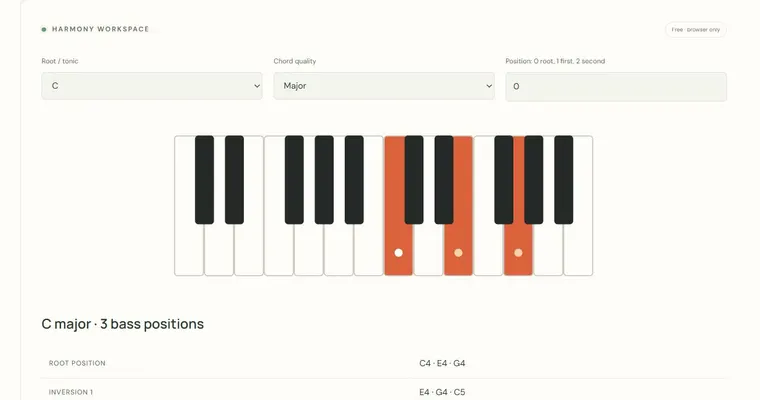
- Reconstruct the formula in the Inversion workbench, compare with another quality on the same root, and test a new hidden question.
A concrete example
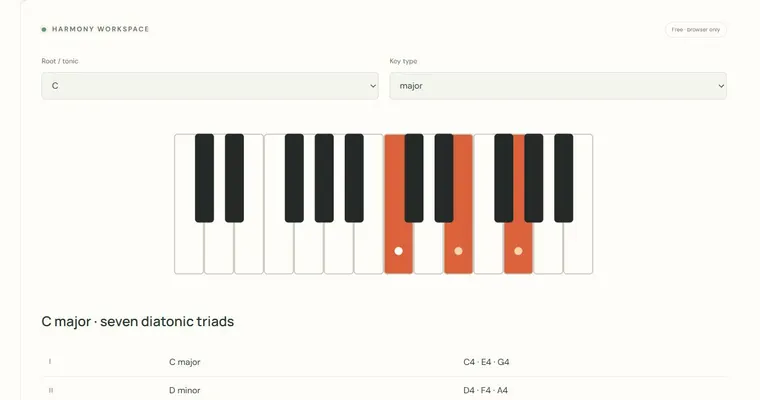
On C, a major triad is C-E-G (0-4-7 semitones) and a minor triad is C-Eb-G (0-3-7). Both share the perfect fifth G. A diminished triad is C-Eb-Gb (0-3-6) and an augmented triad is C-E-G# (0-4-8). Hearing the lowered or raised fifth in those last two is the key difference.
A common wrong turn
Choosing a quality from the overall mood of the chord instead of checking the third and fifth separately, which leads to confusing minor with diminished.
Try this instead: Replay the question and listen once for the third, then once for the fifth. Compare the fifth against a perfect fifth (7 semitones): if it is narrower (6 semitones), the chord is diminished; if it is wider (8 semitones), it is augmented.
Where to go next — and why
This guide was drafted with Claude Haiku and edited against this tool’s implemented controls. Report a confusing instruction or incorrect example.