Make interval ear trainer part of your practice
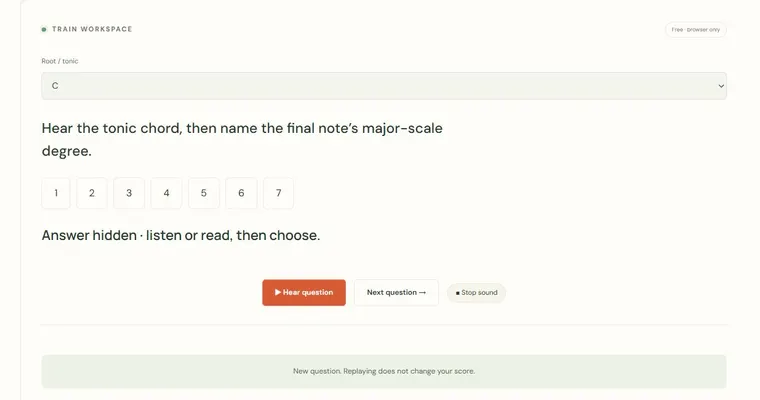
The Interval ear trainer asks you to hear two notes played in order, decide how far apart they are, and then check your answer against a revealed explanation. It is a listening exercise inside this tab only: you answer with buttons, and the tool scores only those button answers. Use it to build a stable sense of how far apart common intervals sound, and then confirm the results at a physical instrument or in an external app if you want to sing or play the pair yourself.
What the result means
Each question gives you a hidden pair of pitches. The first note is your chosen root, so you always have a fixed reference, and the second note changes. The answer choices are major second, minor third, major third, perfect fourth, perfect fifth, major sixth and octave. An answer is correct when your choice matches the number of semitones between the two notes. The explanation then shows both pitches and the exact semitone distance, so a right or wrong result is always tied to a measurable fact rather than a vague impression.
Why it helps
Interval recognition is a matter of comparing distance, not memorizing isolated sounds. Pairing each interval with its semitone count gives you a concrete rule: a perfect fifth is seven semitones, a minor third is three, a major third is four. Because only the first answer to each question affects your session score, you practise committing to a judgment rather than guessing repeatedly. Reviewing the explanation after each answer shows you exactly which distances you confuse, such as a minor third and a major third, which are one semitone apart.
Reading the score honestly
The score reflects button answers in this tab. It is not a measure of hearing ability, musical talent, or a certified assessment, and it does not use a microphone or track progress over time. Audio-device latency and playback volume can change how the pair sounds, so if an answer feels wrong, check your output settings before drawing conclusions.
Try it step by step
- Set the Root / tonic field to C so every question uses the same starting reference.
- Press the replay control to hear the hidden pair, replaying as often as you need before choosing.
- Make one answer, then read the explanation to see both pitches and their semitone distance.
- At a physical instrument or in an external app, play or sing the pair yourself and compare it with the explanation before starting a new question.
A concrete example
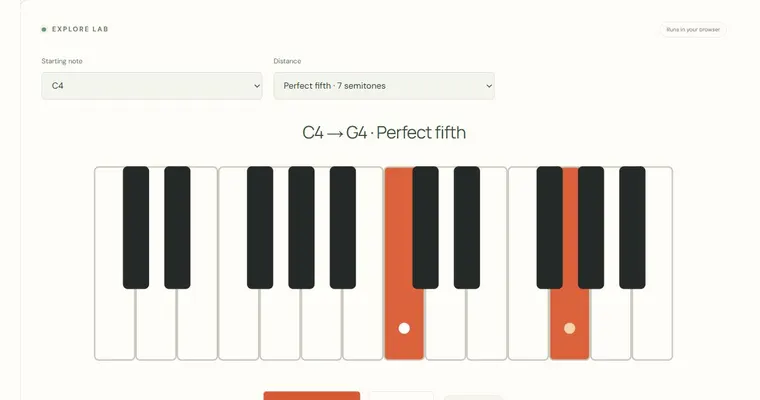
With C selected, C4 followed by G4 is a perfect fifth, which is seven semitones. C4 followed by E-flat4 is a minor third, which is three semitones. If you hear the second pair and choose perfect fifth, the explanation will show E-flat4 and three semitones, revealing that the distance is a minor third, not a fifth.
A common wrong turn
Choosing a major third when the pair is a minor third, because both sound 'wide' and the choice is made from the feeling of brightness alone.
Try this instead: Replay the same hidden question and compare its two pitches before answering. After the answer is revealed, check the semitone count: a minor third has three semitones and a major third has four. Use the interval explorer for a separate comparison if you want to hear those distances with visible note names.
Where to go next — and why
This guide was drafted with Claude Haiku and edited against this tool’s implemented controls. Report a confusing instruction or incorrect example.