Make functional scale-degree trainer part of your practice
The Functional scale-degree trainer asks you to hear a tonic chord, then identify a single note from the major scale built on that tonic. Instead of naming an isolated interval, you learn to hear each pitch as a role within a key, which is the basis of functional listening.
What a degree number means
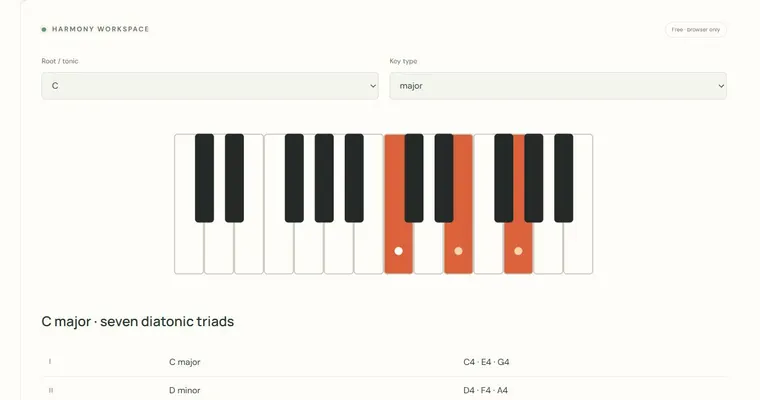
A scale degree is the position of a note in the major scale, counted from the tonic as degree 1. In C major the degrees are C (1), D (2), E (3), F (4), G (5), A (6) and B (7). Answering with a number tells you the role of the pitch relative to home, not just its name. The revealed explanation names the target pitch and its role so you can connect the number to the actual note.
Why the tonic is the anchor
The short tonic triad establishes the home pitch before the gap. Your ear keeps that centre and judges the following note against it. This is why the same degree sounds familiar in any key: in G major, a G–B–D tonic chord followed by E also asks for degree 6, even though the absolute pitch is different. Practising the relationship rather than a single absolute note builds a transferable skill.
Why changing the root helps
The Root / tonic setting stays fixed until you change it. After several questions, try another tonic and compare the same scale-degree relationship at different pitches. The session score records button answers; it does not identify sung notes or measure progress outside this tab.
Try it step by step
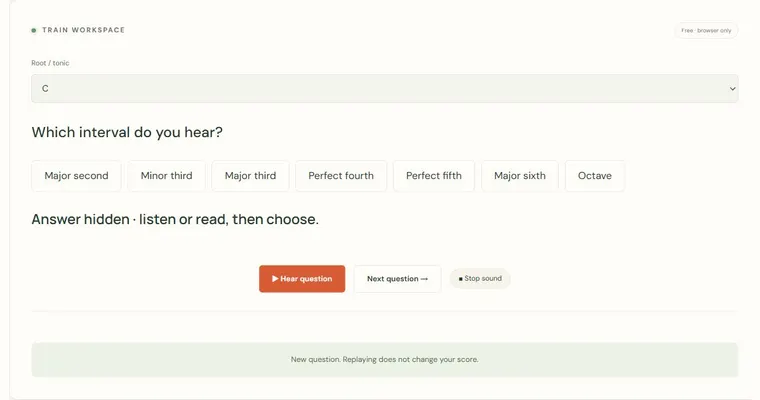
- Set the Root / tonic field to the key you want to practise and listen to the hidden question. Use the audio control to replay the single question as needed; playback is not automatic.
- Silently recall the major scale built on that tonic, counting the seven pitches from 1 to 7 so the target has a clear position.
- Choose the degree number from one to seven that matches the note you heard after the tonic chord, then submit your answer.
- Read the revealed explanation, name the target pitch, and open the interval explorer to compare it with the tonic. Repeat several questions before changing the root field.
A concrete example
In C major, C–E–G followed by A asks for degree 6. In G major, G–B–D followed by E also asks for degree 6: the G-major scale is G, A, B, C, D, E, F#, G. The tonic changes, but E occupies the sixth degree in G major.
A common wrong turn
Counting from the last or highest note of the opening chord, or giving a pitch letter when the task asks for a degree number.
Try this instead: Treat the complete opening triad as a cue for its tonic. Count major-scale degrees from that tonic, with tonic = 1, then check the revealed target pitch after answering.
Where to go next — and why
This guide was drafted with Claude Haiku and edited against this tool’s implemented controls. Report a confusing instruction or incorrect example.