Make scale identification trainer part of your practice
The Scale identification trainer plays one hidden ascending collection on a fixed tonic and asks you to choose among five options: major, natural minor, Dorian, Mixolydian, or major pentatonic. The tonic, register, timing and sound stay constant, so the only thing changing is which pitch classes appear. Use it to train attention to a few characteristic degrees rather than to a general feeling of mood.
What a result tells you
Each question ends on the octave, so every collection is heard as a complete ascending series from the root back to the root an octave higher. A correct answer means you matched the collection that was played, not that you identified a key in a real song. Because the five collections share many notes, a single miss usually points to one degree you did not hear clearly, such as the third or the sixth. Review which degree differed rather than focusing on the overall score.
Why the comparison helps
The major and natural minor collections differ mainly in the third, sixth and seventh degrees. Dorian keeps a minor third but raises the sixth relative to natural minor. Mixolydian keeps a major third but lowers the seventh. The major pentatonic collection has only five pitch classes, so it omits the fourth and seventh degrees and is easy to confuse with major when the phrase is short. Hearing these contrasts against the same tonic builds a reliable reference for recognizing modes and collections in music you hear elsewhere.
Limits of the exercise
The five choices are a fixed set. The exercise does not include chromatic ornaments, changing harmony, or other scale conventions, and the semitone formula revealed after answering defines the exact notes used. Relative keys are a separate idea: C major and A natural minor share the same pitch classes, but this trainer always uses the stated tonic, so it asks about collection shape on that tonic rather than about which relative key a song belongs to. As a practical note, the audio plays only when you press replay, and volume or device latency can change how clearly you hear each degree. Work at a physical instrument or with an external app if you want to check the sound against your own playing.
Try it step by step
- Set the Root / tonic control to the tonic you want to practise, then press replay to hear one hidden question.
- Replay as many times as needed before answering, listening for one characteristic degree at a time, such as whether the third is major or minor.
- Choose a collection and read the revealed semitone formula, then compare it with what you heard.
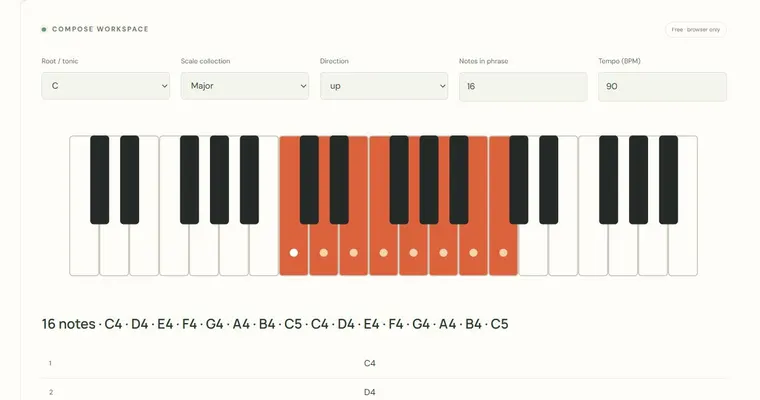
- Open the scale sequencer with the same root, set the collection and direction, and generate the phrase so you can hear the same collection as a timed sequence.
A concrete example
On a C tonic, C major uses the semitone pattern 2-2-1-2-2-2-1, giving C D E F G A B C. C Mixolydian keeps the major third and lowers the seventh, giving C D E F G A B-flat C. Listen for B natural versus B-flat on the last note before the octave.
A common wrong turn
Judging the collection from only the opening notes and treating the answer as a key identification for a whole piece.
Try this instead: Replay the question and listen specifically to the third, sixth and seventh degrees, then check the revealed semitone formula. Remember the trainer identifies a collection on a fixed tonic, not the key of a song.
Where to go next — and why
This guide was drafted with Claude Haiku and edited against this tool’s implemented controls. Report a confusing instruction or incorrect example.