Make scale pattern sequencer part of your practice
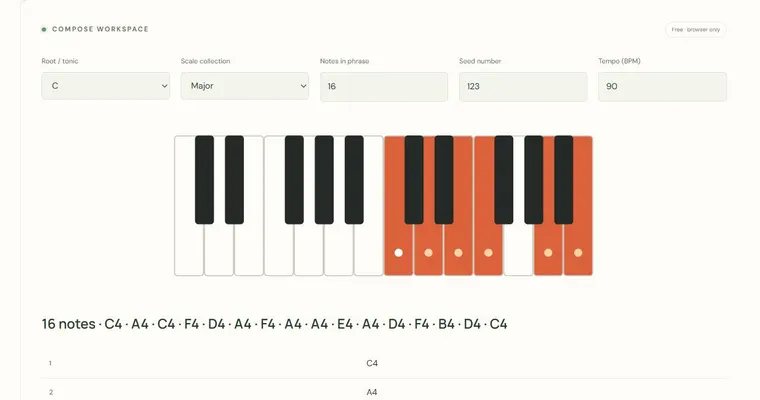
The Scale pattern sequencer turns a scale collection into a timed phrase you can hear and read. Choose a root, a collection, a direction, a phrase length and a tempo, then listen to one finite example. Its purpose is to make note order and rhythm explicit so you can compare collections at the same tempo.
What the result shows
The phrase lists note names in order, starting in the fourth octave of the selected tonic and including the octave above. Each note start falls on a half-beat grid, so every note is placed in time rather than left to chance. The phrase length sets where the example ends or repeats, and the direction sets whether the notes ascend, descend or move up and then back down.
Why the note names matter
Labels follow the chosen root and the scale degrees of the collection, including any accidentals that collection requires. A major scale on C uses C, D, E, F, G, A, B. The natural minor scale on the same tonic uses E-flat, A-flat and B-flat instead of E, A and B, and Dorian keeps the flat third but raises the sixth. Reading these spellings lets you see exactly which pitches change between collections.
Why a finite example helps
Because the sequencer plays one finite example rather than a continuous loop, you can hear a clear beginning and end. Keeping the tonic and tempo fixed while switching collections isolates the change in pitch content, which is the comparison the tool is built for. The result is a reference you can revisit, not a guarantee of musical mastery.
Try it step by step
- Set Root / tonic to C, Scale collection to Major, Direction to up, Notes in phrase to 16 and Tempo to 90 BPM, then play the phrase.
- Change only Scale collection to Natural minor and identify which notes became flatter than in the major version.
- Change Scale collection to Dorian and confirm that the sixth degree is a major sixth, unlike natural minor.
- Set Direction to updown, count the notes in one ascent and descent, and practise on a physical instrument or in an external app if you wish to play it yourself.
A concrete example
C major ascends C4, D4, E4, F4, G4, A4, B4, C5. Switching to C Dorian keeps C as the tonic and the tempo fixed while the third becomes E-flat and the seventh becomes B-flat, giving C4, D4, E-flat4, F4, G4, A4, B-flat4, C5.
A common wrong turn
Changing the root, collection and direction together, then assuming one change caused the difference heard.
Try this instead: Change one control at a time while keeping the others fixed, so each difference in the note names and sound can be traced to a single setting.
Where to go next — and why
This guide was drafted with Claude Haiku and edited against this tool’s implemented controls. Report a confusing instruction or incorrect example.