Make circle of fifths part of your practice
The circle of fifths is a map of how keys relate by fifths. Starting from a tonic, each step clockwise moves up a perfect fifth, which is seven semitones. Twelve such steps visit all twelve pitch classes and return to the start. This guide shows how to read the ring, the relative minor pairing and the neighboring keys, and how to use those relationships with the other tools.
What a step on the ring means
Each clockwise move adds seven semitones modulo twelve. From C the sequence begins C, G, D, A. Twelve equal-tempered fifths total 84 semitones, exactly seven octaves, so the pitch-class cycle closes. This calculation uses equal-tempered fifths, not a chain of acoustically pure 3:2 ratios. Playback places root notes within one octave; adjacent notes can therefore move down in register even while their pitch classes follow the fifths cycle.
Why neighbors share notes
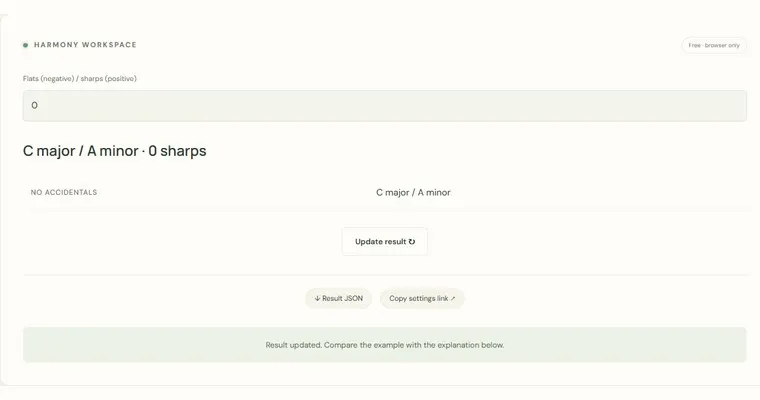
Keys that are neighbors on the ring differ by one pitch class in their scales. C major and G major share six of their seven notes; G major adds F sharp. This is why neighboring keys sit side by side and why a key signature changes by a single accidental as you move one step. The relative minor sits nine semitones above a major tonic, so C major pairs with A minor, and both use the same notes without accidentals. Pairing a major tonic with its relative minor is a fact about shared pitch content, not about which key a passage ends in.
What the ring does not tell you
The ring does not say which key a piece is in, which chord is the tonic or how a progression should move. A tonic chord is the triad built on the key's first scale degree, and its function depends on context: harmony, cadences and emphasis decide tonality, not the ring. Names on the ring use a compact mixed spelling, so they are not full key-signature spellings. Use the key signature tool to read the sharp or flat order for a specific key.
Explore the selected key
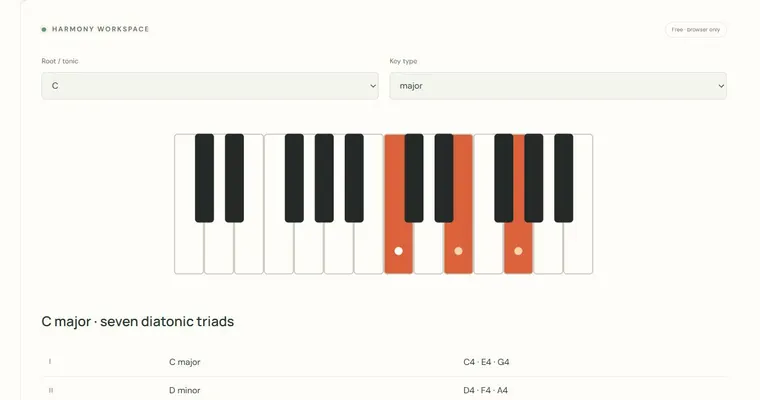
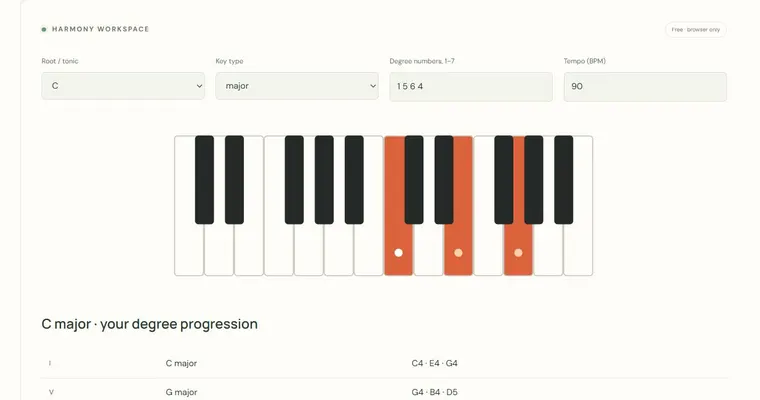
Click a key on the ring to update its major/relative-minor pairing, key-signature summary and seven diatonic triads. Read the selected-key panel separately from the complete fifths tour. The tour’s playback still sounds root notes; use Chords in a key or the progression tools to hear triads.
Try it step by step
- Set the Root / tonic field to C and confirm the clockwise neighbor is G.
- Note the relative minor for C (A) from the ring and verify the pairing.
- Click the G key on the ring to make it the new starting point and read the new relative minor, E.
- Press the audio control once to hear the finite root-note example, then, at a physical instrument, play C, G and D yourself to hear the fifths directly.
A concrete example
Start on C. One clockwise step is G, seven semitones above C. Another step is D, which is 14 semitones above C, reduced to 2 by taking modulo 12. C major pairs with A minor (A is nine semitones above C) and both have no sharps or flats. G major has one sharp, F sharp, and pairs with E minor.
A common wrong turn
Confusing a relative minor with a parallel minor, or assuming the first entry on the ring proves the key of a piece.
Try this instead: C major and A minor are relative keys: they share a key signature but have different tonic centers. C major and C minor are parallel keys: they share C as tonic but have different note collections. Use musical context to identify the key of a passage.
Where to go next — and why
This guide was drafted with Claude Haiku and edited against this tool’s implemented controls. Report a confusing instruction or incorrect example.