Make sixteen-step drum sketchpad part of your practice
The Sixteen-step drum sketchpad lets you place kick, snare and hi-hat hits on a shared grid of sixteen sixteenth-note columns, then play one bar at your chosen tempo. It is a practical way to see how subdivisions divide a bar and how separate rhythmic lines fit together. Playback here is a single finite bar, not a continuous backing track, and the preview uses synthesized drum-like sounds rather than a sampled acoustic kit.
What the grid shows
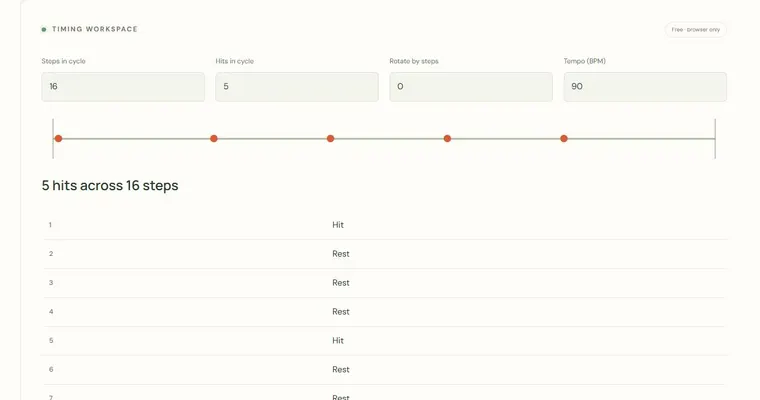
Each column is one sixteenth note. In a bar of four quarter-note beats, steps 1, 5, 9 and 13 fall on the beats, while steps 3, 7, 11 and 15 are the eighth-note offbeats and the remaining columns are the sixteenth-note subdivisions. When a cell is on, it marks a hit on that subdivision. A rest is simply an empty cell, so silence is as much a part of the pattern as the hits.
Why this helps
Seeing hits placed on a fixed grid makes the relationship between rhythm and subdivision concrete. You can notice that a hi-hat on every other step is an eighth-note pulse, while a hit on step 2 is a sixteenth note between beats. Because the three rows sound together on the same steps, you also learn how a kick, snare and hi-hat interact: where they coincide, where they alternate, and where a gap changes the feel.
Tempo and the quarter-note beat
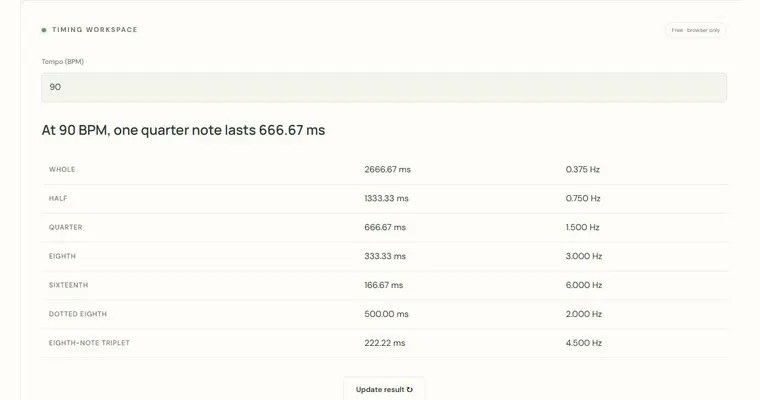
The tempo field is in BPM and always counts quarter notes. At 90 BPM, one quarter note lasts 60 divided by 90, which is about 0.667 seconds, so one sixteenth note lasts about 0.167 seconds. A full bar of sixteen steps therefore lasts about 2.67 seconds. Changing the tempo changes how fast the grid is traversed, but the pattern itself stays the same.
Try it step by step
- Use Clear grid to remove the default pattern, set 90 BPM, and keep the tempo fixed while editing.
- Turn on kick at steps 1 and 9 and snare at steps 5 and 13, then play the bar and listen to how they fall on the beats.
- Turn on hi-hat on every odd-numbered step, play again, and count the eighth-note pulse across the four beats.
- Remove one hi-hat hit and add a kick between two main beats, then compare the original and edited patterns at the same tempo.
A concrete example
Kick on steps 1 and 9 lands on beats 1 and 3; snare on steps 5 and 13 lands on beats 2 and 4. Adding hi-hat on every odd step gives eight hits across four beats, spaced one eighth note (about 0.333 seconds at 90 BPM) apart.
A common wrong turn
Filling every step so that no rests remain, which removes the space that gives a pattern its groove.
Try this instead: Leave deliberate gaps as rests, play the bar with those gaps, and only add hits where they serve the feel you want.
Where to go next — and why
This guide was drafted with Claude Haiku and edited against this tool’s implemented controls. Report a confusing instruction or incorrect example.